
3 Reasons Your Hard-Wired Smoke Detector Is Chirping (and 3 More Homeowners Often Miss)
Last Updated: August 2026
A hard-wired smoke detector that keeps chirping is usually telling you its 9-volt backup battery is dying. If a fresh battery and a reset don't silence it, the detector has likely reached the end of its 7-10 year lifespan, or a wiring issue needs a licensed electrician's attention. Don't ignore it, and don't disconnect it.
On this page:
Why Is Your Detector Beeping?
How to Stop and Reset It
3 More Reasons It Chirps
Is Your Detector Too Old?
What the Sounds Mean
4 Common False Alarms
FAQs
Few household sounds are more maddening than a smoke detector chirping every 30 seconds — especially when it starts at 2 a.m. But that chirp is your detector doing its job. Smoke alarms are among the most important safety devices in your home, and a hard-wired smoke detector chirping intermittently is warning you that something is preventing it from protecting your family the way it should. Most of the time a battery change solves it. When it doesn't, the beeping is pointing to something worth investigating.
Why Is Your Hard-Wired Smoke Detector Beeping?
When a hardwired smoke detector chirps, the three most common culprits are a depleted backup battery, dust inside the unit, or a detector that has simply grown old and defective. Let's look at each one and how to fix it.
1. Dead Backup Batteries
It surprises many homeowners, but this is the answer to "why is my hard wired smoke detector chirping" in the majority of cases. Even though your detector is wired directly into your home's electrical system, it contains a 9-volt backup battery that keeps it running during power outages. When that battery's charge runs low, the detector emits a regular chirp, typically once every 30 to 60 seconds, to tell you it can no longer guarantee protection if the power goes out.
The solution is simple: replace the backup battery. Use a fresh, name-brand 9-volt (check the battery compartment or manual, as some newer models use AA batteries or sealed 10-year lithium cells), and make sure it's seated firmly against both terminals. A loose battery chirps just like a dead one.
Don't wait for the chirp to tell you it's time: the National Fire Protection Association (NFPA) recommends replacing backup batteries proactively every six months, on a schedule, rather than only when the low-battery warning starts. Changing all your smoke detector batteries at once, on a date you'll remember, is the simplest way to never hear that 2 a.m. chirp in the first place.
2. Excess Dust
Your smoke detector senses smoke by monitoring the air inside a small sensing chamber. Over time, dust, cobwebs, and even fine construction debris can infiltrate that chamber, and the detector reads the obstruction as a malfunction, triggering chirps and occasionally false alarms.
To clean it safely, first turn off the detector's circuit at your breaker panel. Then remove the unit, and use a vacuum's soft-brush attachment or a can of compressed air to gently clear the vents and sensing chamber. Never open the sealed sensor housing itself. If you're not comfortable working around a hard-wired device, there's no shame in that. A professional can clean and test the unit safely in minutes.
3. Old and Defective Detector
Smoke detectors don't last forever. The sensors inside degrade with age, and after roughly ten years of service, a detector's reliability drops off enough that manufacturers and fire-safety agencies alike say the same thing: replace the whole unit, not just the battery.
NFPA 72, the National Fire Alarm and Signaling Code, specifically calls for replacing all smoke alarms — including hard-wired units and those with 10-year batteries — at 10 years old, or sooner if they don't respond properly when tested.
Many modern detectors are actually programmed to emit a persistent end-of-life chirp when they reach this point. An end-of-life chirp cannot be permanently silenced. No battery change will fix it. The unit is telling you its sensing days are done, and replacement is the only cure.
How to Stop and Reset a Chirping Hard-Wired Smoke Detector
If the chirping has started, work through these steps in order. This sequence resolves the overwhelming majority of chirping complaints:
Cut power at the breaker. Hard-wired detectors carry live household voltage. Before you touch the unit, switch off its circuit at your electrical panel.
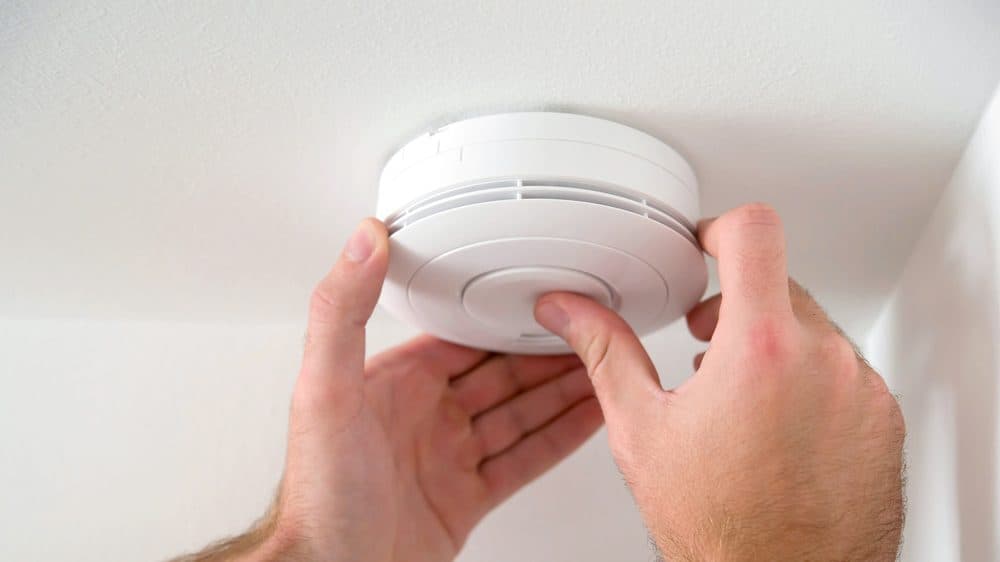
Remove the detector from its mounting bracket. Most units twist off; some release with a tab. Unclip the wiring harness if you need more slack.
Replace the backup battery. Swap in a fresh 9-volt (or the battery type your model specifies), making sure it snaps firmly onto both terminals.
Hold the test/reset button for 15-20 seconds. This drains residual charge from the unit's capacitor and clears the error state that can keep a detector chirping even after a new battery is installed.
Reattach the unit and restore power. Re-seat the wiring harness, twist the detector back onto its bracket, and flip the breaker back on.
Test the alarm. Press the test button briefly; a healthy detector will sound its full alarm. If the chirping resumes within a day, move on to the causes below — the problem isn't the battery.
Still chirping after a fresh battery and a full reset? At that point, the cause is usually wiring or end-of-life, both of which deserve a professional's eyes. Casteel's licensed electricians have served metro Atlanta homeowners for nearly 40 years with same-day, on-time guaranteed service, and professional smoke detector installation and replacement is one of our most common calls. Give us a ring at 770-852-8504 — we'll solve it for you.
3 More Reasons a Hardwired Smoke Detector Chirps
If the big three didn't solve it, one of these lesser-known causes is likely at work.
4. Loose Wiring or Connector Issues
A hard-wired detector depends on a snug connection to your home's electrical system. A wiring harness that has worked slightly loose, a worn connector, or a degraded wire nut can cause the detector to intermittently lose AC power. Every time it does, it chirps as it switches to battery backup. If you noticed the chirping began after another electrical project in your home, or if it comes and goes with no pattern, suspect the connection. Because this involves live household wiring, diagnosis and repair belong to a licensed electrician rather than a DIY afternoon.
5. Power Interruptions and Surges
Brief brownouts, flickering power, and surges — common during Georgia's summer thunderstorms — can make hard-wired detectors chirp or even sound briefly as they toggle between AC power and battery backup. A chirp or two during an outage is normal. But if your detectors chirp every time the lights flicker, or keep chirping after power stabilizes, the interruptions may be exposing a weak backup battery or a failing unit. Frequent unexplained surges themselves are worth investigating with a professional electrical inspection, since they can stress far more than your smoke alarms.
6. Humidity and Temperature Swings
Ever wonder why smoke detectors seem to chirp only in the middle of the night? It's not bad luck. As overnight temperatures drop, particularly in homes where the thermostat setbacks kick in, or for detectors mounted near attics, garages, or bathrooms, a marginal battery's voltage output dips just enough to cross the low-battery threshold, and the 3 a.m. chirping begins.
High humidity from a steamy bathroom can similarly confuse the sensing chamber. If your detector chirps at night but seems fine by day, its battery is on the edge: replace it now rather than waiting for the next cold night.
Is Your Detector Too Old? Here's How to Check
Every smoke detector has a date of manufacture printed on a sticker on the back of the unit. Twist the detector off its bracket (cut the breaker first) and look for it. The rule is simple: if the manufacture date is more than 7–10 years ago, replace the detector.
Sensor sensitivity declines invisibly with age, and a ten-year-old detector can pass its button test while responding dangerously slowly to real smoke. If the date sticker is missing or unreadable, that's itself a strong sign the unit predates current standards and should go. Casteel's smoke detector replacement services can swap every aging unit in your home in a single visit, with interconnected, code-compliant detectors placed where Georgia code requires them.
What the Sounds Mean: Chirps, Beeps, and Patterns
Not every noise from a smoke detector means the same thing. Here's a quick decoder:
One chirp every 30-60 seconds: low backup battery or end-of-life.
Chirping that persists after battery replacement and reset: end-of-life warning or a wiring/power issue.
Continuous, repeating loud alarm: smoke or fire detected. Treat it as real until proven otherwise.
Intermittent chirps with no pattern: loose wiring, power fluctuations, or dust in the sensing chamber.
One more wrinkle worth knowing: in most modern homes, hard-wired detectors are interconnected. When one sounds, they all sound. That's a lifesaving feature during a fire, but it also means a single failing unit can set the entire house chirping. To find the culprit, listen to each detector individually; the failing unit typically chirps a beat before the others echo it, and its indicator light often blinks differently. Check that unit's date sticker first.
4 Common Smoke Detector False Alarms
Chirping is one thing. Full false alarms are another. If your detector periodically erupts for no apparent reason, one of these four causes is usually behind it:
Installation location. Detectors installed within ten feet of cooking appliances, or near drafty windows and doors, will trigger unnecessary alarms from everyday activity. Relocation solves it.
Overcooked food. If a correctly positioned detector still sounds every time dinner browns a little too far, its sensitivity may need professional adjustment.
Steam and humidity. Dense steam from a bathroom can scatter enough particles to trigger an ionization sensor just like smoke.
Insects. Small insects occasionally find their way inside a detector and interfere with the sensor. A careful cleaning (breaker off first) usually evicts them.
Smoke Detector Replacement and Repair Services in Metro Atlanta
Whether your hard-wired smoke detector is chirping through the night, failing its test button, or simply past its seventh birthday, Casteel's expert electricians can help. For nearly 40 years, homeowners have trusted Casteel because we show up when we say we will. We offer same-day service and 24/7 emergency electrical repair, and we back our work with a satisfaction guarantee — from our licensed team (GA Electrical License EN215639).
Our team can inspect every detector in your home, replace aging units with interconnected code-compliant models, and leave you with protection you don't have to think about — or listen to. Call 770-852-8504 or book online with Casteel's electrical services today.

Chirping smoke detector FAQs
Why does my hardwired smoke detector keep chirping after I changed the battery?
Residual charge in the unit can keep the error state alive. Cut power at the breaker, remove the detector, and hold the test button 15-20 seconds to fully reset it. If chirping continues, the detector is likely at its 7-10 year end of life or has a wiring issue needing an electrician.
How do I reset a hardwired smoke alarm?
Turn off the detector's circuit at the breaker, remove the unit from its bracket, take out the backup battery, and hold the test/reset button for 15-20 seconds. Reinstall a fresh battery, remount the unit, restore power, and press test once to confirm the alarm sounds normally.
Why does my smoke alarm chirp in the middle of the night?
Battery output drops as temperatures fall overnight. A backup battery that's merely weak by day can dip below the low-battery threshold during the coldest early-morning hours, triggering the chirp. It isn't random; it's a warning that the battery is nearly done. Replace it promptly and the 3 a.m. chirping stops.
How long do hardwired smoke detectors last?
Hard-wired smoke detectors last 7-10 years, even with regular battery changes. The sensors inside degrade with age, and many units emit an unsilenceable end-of-life chirp when expired. Check the manufacture date printed on the back of the unit, and replace the entire detector — not just the battery — once it passes that window.
How often should I replace smoke detector batteries?
Don't wait for the chirp. NFPA recommends replacing backup batteries every six months on a fixed schedule — many households do it when clocks change for daylight saving time, which makes it easy to remember for every detector in the house at once.
Related Articles
What do you need help with today?
Heating
No heat, strange smells, rising bills? We repair and replace heating systems to keep your home reliably warm.
Air Conditioning
AC blowing warm air? Uneven cooling in your rooms? We fix cooling issues fast and keep your system running smoothly all summer.
Plumbing
Our highly trained plumbers handle it all, from leaky faucets to full system installations and repipes.
Electrical
The smartest team in town. You need repair, installations, wiring, inspections, lighting — you name it.