
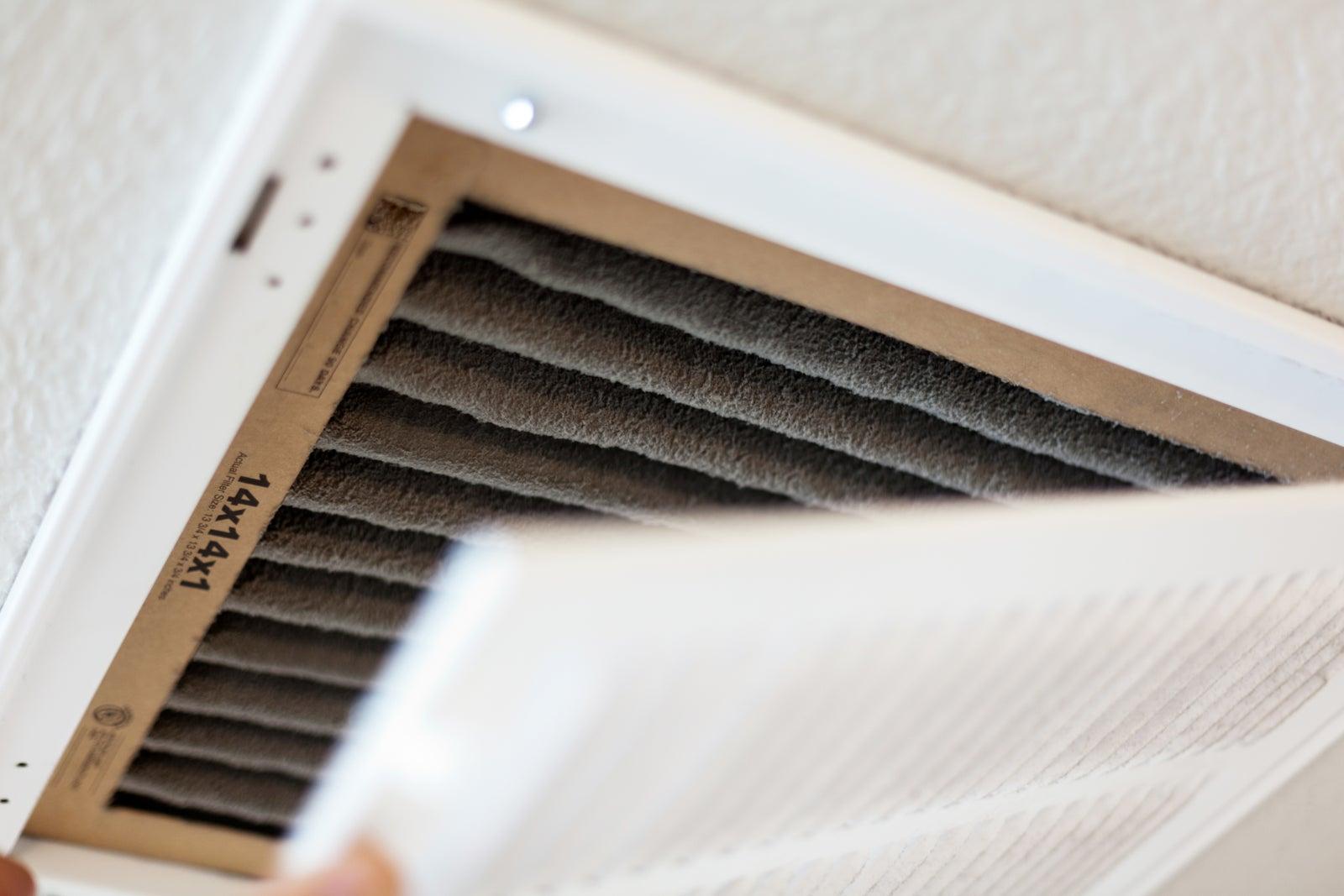
Quick answer: To change your AC filter, turn the system off, open the return vent or filter slot, and slide out the old filter. Note its size and airflow arrow, then insert a new filter of the same size with the arrow pointing toward the unit. Most 1-inch filters need replacing every 1 to 3 months. Check yours monthly during Georgia's long cooling season.
On this page:
What an AC filter does
Where your filter is
What size you need
MERV rating chart
How to change it
How often to change it
Signs it needs changing
What happens if you don't
What it costs
When to call a pro
FAQs
Changing your AC filter is one of the easiest jobs in home maintenance. It takes about five minutes and no tools. It's also one of the most skipped, and our technicians see what happens next: dust-caked coils, frozen refrigerant lines, and systems straining through a Georgia summer.
This guide covers how to change your AC filter, which size and MERV rating to buy, and how often to swap it. If your system still isn't cooling after a fresh filter, Casteel offers same-day AC repair across the greater Atlanta area. Call 770-852-8504.
What Does an AC Filter Do?
An AC filter is a framed sheet of fiber or pleated material that cleans air before it enters your heating and cooling system. It traps dust, pollen, lint, and pet hair so they don't build up on the blower and the evaporator coil, the part that cools the air.
In most homes with central air, the AC filter and the furnace filter are the same filter. The system pulls air through it whether it's heating or cooling.
Where Is Your AC Filter?
Most central systems keep the filter in one of two places.
In a Return Air Vent
Look for a large grille on a wall or ceiling, often in a hallway. Return vents pull air in rather than blow it out. If the grille has latches or clips, the filter is usually right behind it.
In the Air Handler or Furnace
If your return vents have no filter, check the indoor unit in your basement, attic, garage, or closet. The filter usually slides into a slot between the return duct and the unit, behind a thin cover.
Homes With More Than One Return
Larger and two-story homes often have several returns or two systems. Check each one, since every filter needs changing.
Window units and ductless mini-splits use washable mesh filters instead. Follow the owner's manual for those.
What Size AC Filter Do You Need?
How to Find Your Filter Size
The size is printed on the frame of your current filter as length × width × depth, such as 16x25x1. That's the nominal size, which is rounded up. The actual filter is usually slightly smaller so it slides in easily. Buy the same nominal size. If the label is worn off, measure the slot, not the old filter.
A filter that's too small leaves gaps, and air takes the easy way around it.
Disposable vs. Washable Filters
Most central systems use disposable filters with cardboard frames. Don't wash these, because water damages the filter material. Washable filters have plastic or metal frames and can be rinsed, dried completely, and reused. Check the label if you're not sure which you have.
MERV Rating Chart: Which MERV Is Right for Your Home?
MERV, short for Minimum Efficiency Reporting Value, measures how well a filter captures particles between 0.3 and 10 microns, on a scale of 1 to 16. The right rating depends on two things: how much filtration your household needs and how much your system can handle. MERV 8 covers everyday dust for most homes. If you want cleaner air, the EPA advises choosing at least MERV 13, or the highest rating your system's fan and filter slot can handle, and checking with an HVAC technician first.
Which MERV Is Right for Your Georgia Home?
MERV | Best for | Georgia note |
|---|---|---|
8 | Most homes; everyday dust and lint | A solid baseline for year-round use |
11 | Homes with pets or allergy sufferers | Helpful during spring tree pollen season |
13 | Asthma, smoke, or maximum filtration | The EPA's minimum for an upgrade, if a technician confirms your system can handle it |
MERV 8 vs. MERV 13: What's the Difference?
MERV 13 captures far more fine particles. It must trap at least 50% of particles between 0.3 and 1 micron, while MERV 8 has no minimum for that size. The trade-off is airflow. A denser filter can restrict airflow in a system that wasn't built for it, making the system work harder. Before you upgrade, have a technician confirm your system can handle it. Casteel's indoor air quality specialists can help you choose.
What Each MERV Rating Captures
Higher ratings trap more small particles. This chart shows what each rating can catch, not which one to buy.
MERV rating | Small particles (0.3–1 µm) | Medium particles (1–3 µm) | Large particles (3–10 µm) |
1–4 | No minimum | No minimum | Under 20% |
5–8 | No minimum | 20% (MERV 8 only) | 20% to 70% |
9–12 | 20% to 35% (MERV 11–12 only) | 35% to 80% | 75% to 90% |
13–16 | 50% to 95% | 85% to 95% | 90% to 95% |
Capture-efficiency thresholds by particle size. Source: U.S. EPA.
How to Change Your AC Filter in 6 Steps
Changing your AC filter takes about five minutes:
Turn the system off at the thermostat so it doesn't pull dust in while the slot is open.
Remove the old filter. Open the grille or slot cover and slide the filter out.
Check the size and arrow. Note the size printed on the frame and which way the arrow points.
Insert the new filter with the arrow pointing toward the unit, away from the return grille. Make sure it sits flat with no gaps around the edges.
Close it up and date it. Write today's date on the frame.
Turn the system back on and set a reminder for your next check.
What Happens If You Change Your AC Filter Wrong?
Small mistakes can undo the job:
Backwards arrow. The filter won't work as designed.
Gaps around the edges. Unfiltered air slips around the filter.
Wrong size. A loose filter leaves gaps; a tight one can bend.
No filter, even briefly. Dust goes straight to the coil and blower.
When dust reaches the coil, a new filter won't clean it off. That takes AC maintenance from a technician.
How Often Should You Change Your AC Filter?
Check your AC filter once a month and replace it when it looks dirty. The U.S. Department of Energy's Energy Saver Guide advises cleaning or replacing air conditioner filters once a month or as recommended. Filter makers generally recommend replacing 1-inch filters every 1 to 3 months and 4- to 5-inch media filters about every 6 months. Pets, allergies, and dust shorten those intervals.
Situation | When to replace |
|---|---|
1-inch filter, average home | Every 1 to 3 months |
4- to 5-inch media filter | About every 6 months |
Pets, allergies, smoking, or renovation dust | Check monthly; replace sooner |
Georgia Filter Schedule
Georgia condition | When to check |
|---|---|
Spring pollen season (tree pollen starts rising in mid-February; counts peak mid-March to mid-April) | At least monthly; more often if the filter looks dirty sooner |
Summer cooling season (June to September) | At least monthly |
Heat pump homes | Monthly, year-round |
Pollen season dates come from Emory Healthcare. Heat pumps both heat and cool, so they run in every season.
Signs Your AC Filter Needs Changing
The filter looks gray or caked with dust.
You can't see light through it when you hold it up.
Airflow from your vents feels weak.
Dust builds up on furniture faster than usual.
The system runs longer to reach your set temperature.
Your energy bills are creeping up.
What Happens If You Don't Change Your AC Filter?
According to ENERGY STAR, "a dirty filter can increase energy costs and damage your equipment, leading to early failure." A clogged filter restricts airflow, which can freeze the evaporator coil, strain the blower, and let more dust and allergens circulate through your home.
When to Call an HVAC Professional
A new filter fixes a lot. But our technicians know a filter can also point to bigger problems. Call a pro if you notice any of these.
Your Filter Is Wet or Moldy
A wet filter usually means condensate isn't draining properly, often from a clogged drain line or a drain pan problem. In Georgia's humidity, that moisture can feed mold quickly. Replace the filter and have the drain checked.
You Put In a New Filter, but the AC Still Isn't Cooling After 24 Hours
Then the filter wasn't the problem. Low refrigerant, a dirty or frozen coil, or an electrical issue could be the cause. See our guide to an AC running but not cooling.
There's Ice on the Coil or Refrigerant Lines
Set the thermostat to OFF and the fan to ON to thaw the ice. Running a frozen system can strain the compressor. Restricted airflow and low refrigerant are common causes, and a technician can find which one it is. See our guide on what to do if your AC freezes up.
Your Filter Is Black
A black or sooty filter can come from candles or a fireplace, mold, or a combustion problem in a gas furnace. Have your heating system inspected.
Need help now? Casteel offers same-day service and 24/7 emergency AC service with no extra fees for emergencies, evenings, or weekends. Call 770-852-8504.
Why Choose Casteel for AC Maintenance
Casteel has served Georgia homeowners since 1987. From our locations in Lawrenceville and Marietta, we offer same-day service across the greater Atlanta area, and we've earned more than 10,000 positive reviews online along the way.
Our licensed technicians (GA HVAC Lic. CR109281) handle everything from filter checks and AC maintenance to repairs and next-day installs. We back our work with warranties and guarantees, including an on-time guarantee, and we never charge extra for emergency, evening, or weekend service.
We Will Take Amazing Care of You. Call 770-852-8504 to schedule.
We serve homeowners in Lawrenceville, Marietta, Atlanta, Alpharetta, Roswell, Duluth, Sandy Springs, Kennesaw, Johns Creek and Woodstock, plus surrounding communities across metro Atlanta.
AC Filter FAQs
Can I run my AC without a filter?
It's best not to. Without a filter, dust and debris go straight to the blower and evaporator coil. Buildup on the coil reduces cooling and can lead to repairs. If you're out of filters, keep the system off until you can install a new one.
Is an AC filter the same as a furnace filter?
In most homes with central air, yes. The heating and cooling system shares one blower and one filter, so the same filter cleans the air in both seasons. Some homes with separate systems or extra returns have more than one filter, so check each unit.
Which way does the arrow go on an AC filter?
The arrow points in the direction air flows: toward the air handler or furnace and away from the return grille. In a ceiling return, the arrow usually points up. In a wall return, it points into the wall.
Can I clean and reuse my AC filter?
Only if it's labeled washable. Most filters have cardboard frames and are disposable, and washing them damages the filter material. Washable filters have plastic or metal frames. Rinse them, let them dry completely, and reinstall them.
Is MERV 8 or MERV 13 better for my home?
It depends on your system. MERV 13 traps far more fine particles, and the EPA advises at least MERV 13 if you're upgrading and your system can handle it. Higher-MERV filters can restrict airflow in systems that weren't built for them, so have a technician check before you switch. For everyday dust, MERV 8 works well in most homes.
Should I change my AC filter more often in summer?
Often, yes. Your system runs longer in summer, so the filter loads up faster. In Georgia, the cooling season is long, so check your filter at least monthly from June through September and replace it when it looks dirty.
Do ductless mini-splits have filters?
Yes. Each indoor unit has washable mesh filters behind the front panel. Clean them according to the owner's manual, usually by rinsing and air-drying.
How long does it take to change an AC filter?
About five minutes, once you have the right filter. Most filters slide out of a return grille or a slot near the indoor unit with no tools. The longest step is usually finding the right size.
Related Articles
What do you need help with today?
Heating
No heat, strange smells, rising bills? We repair and replace heating systems to keep your home reliably warm.
Air Conditioning
AC blowing warm air? Uneven cooling in your rooms? We fix cooling issues fast and keep your system running smoothly all summer.
Plumbing
Our highly trained plumbers handle it all, from leaky faucets to full system installations and repipes.
Electrical
The smartest team in town. You need repair, installations, wiring, inspections, lighting — you name it.