
Quick answer: Trenchless repair is the right call when the existing pipe still holds its shape and the damage runs along the line rather than at a collapse, a severe offset or a failed connection. Open excavation wins when the lateral has collapsed, has lost grade, or has to be re-laid. A camera inspection is what decides between them, and in metro Atlanta the red clay under your yard is a genuine reason these lines fail in the first place.
On this page:
Start with a camera inspection
The two trenchless methods
When digging is the right answer
Georgia clay and root intrusion
Who owns the line to the street
Getting a sewer scope before you buy
FAQs
Most homeowners come to this question already leaning one way. Nobody wants a trench across a front yard they just re-sodded, and the no-dig marketing is persuasive.
The honest position is that neither method is better in the abstract. They solve different failures, and the failure you actually have is a physical fact about the pipe under your grass, not a preference.
What follows is how that decision gets made in the greater Atlanta area, including the part of it that is specific to the ground we dig in.
Start With a Camera Inspection, Not a Method
Any contractor who quotes you a method over the phone is guessing. The pipe either has a continuous, reasonably round path through it or it does not, and that single condition rules half the options in or out.
A sewer line camera inspection runs a self-locating camera from a cleanout through the lateral and reports five things that matter: the pipe material, the condition of the joints, any bellies where the line has sagged and holds water, any offsets where sections have pulled apart, and how much root mass is inside.
It also traces the route of the line across your yard, which is the answer to where your sewer runs. That map is worth having on file even if the camera shows nothing wrong today.
If your fixtures are backing up right now, get the camera run before you agree to anything else. Call Casteel at 770-852-8504.
The Two Trenchless Methods
Both methods rebuild the lateral without opening a trench along its full length, but they do it in opposite ways, and that difference decides which one your pipe can accept.
Pipe Lining
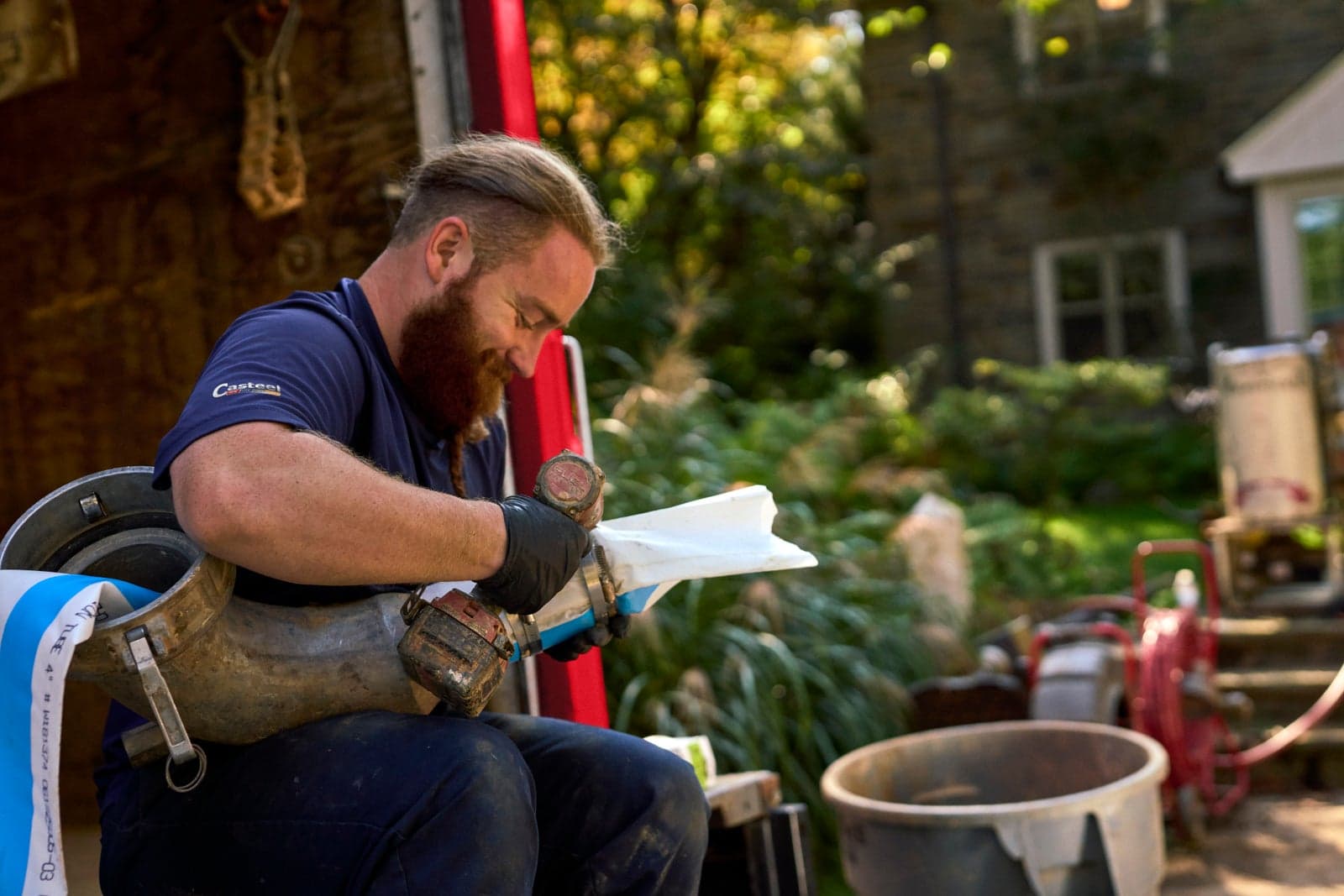
Also called cured-in-place pipe, lining pulls a resin-saturated liner through the existing lateral and cures it in position to form a new pipe inside the old one.
It requires the host pipe to be continuous and reasonably round, because the liner takes the shape of whatever it is cured against. It also gives up a small amount of interior diameter, which is rarely a problem on a residential lateral.
Pipe Bursting
Bursting pulls a conical head through the old pipe, fracturing it outward into the surrounding soil while drawing new pipe in behind it.
It replaces the lateral entirely rather than lining it, can upsize the diameter, and needs an access pit at each end instead of a full trench. Because it does not rely on the old pipe surviving, it tolerates conditions that lining cannot.
On the question of which lasts longer, both are engineered for a service life comparable to new pipe. The meaningful difference is what is already in the ground. Lining depends on the host pipe; bursting discards it. In a lateral with multiple failed joints or a section that has already lost its shape, bursting is the more durable choice.
When Digging Is the Right Answer
Open excavation is not a fallback. It is the correct method in four situations, and a contractor who will not name them is selling you a method rather than a repair.
The first is a true collapse, where there is no continuous path for a liner or a bursting head to follow. The second is a section that has dropped and lost its fall, which has to be re-laid at proper grade because no lining method restores slope.
The third is a connection or a cleanout that has to be rebuilt. The fourth is a single short failure close to the house, where a spot repair is genuinely less disruptive than mobilizing trenchless equipment for a few feet of pipe.
Access decides some of it too. Under a driveway, a retaining wall or a mature root plate, the practical answer sometimes comes down to where equipment can physically sit.
Match the Symptom to What Is Happening Underground
Use this to work out how urgent your situation is before you call.
Symptom | Likely cause | What to do |
A shower drains slower every week no matter what you try | Root intrusion or a partial blockage building in the main lateral | Stop using chemical openers and book a camera inspection |
Several fixtures gurgle when the washing machine discharges | Restriction in the main line, not in a fixture trap | Note which fixtures and when, then have the lateral scoped |
Sewage smell in the front yard after a long wet stretch | A leaking joint or a cracked section saturating the soil | Keep children and pets off the area and call the same day |
Repeat backups at the lowest drain in the house | A failing lateral rather than a fixture clog | Stop running water and call for emergency service |
A soft or sunken strip of lawn along the line's route | Soil washing into a broken pipe below | Do not drive or park on it, and get it scoped before it collapses |
Toilets will not flush anywhere in the house | A fully blocked or collapsed lateral | Shut off water to fixtures and call today |
Georgia Red Clay and Why Laterals Fail Here
Yes, soil movement is a real contributor in metro Atlanta, and it is not a sales line.
Georgia red clay shrinks as it dries through a hot August and swells again when the fall rain arrives. That cycle repeats every year, and it works on buried pipe the way repeated flexing works on anything else.
What it damages is rarely the middle of a pipe run. It is the joints between sections, because a joint is where the line can move relative to itself. Older jointed materials are the vulnerable ones: cast iron and clay tile laterals are jointed every few feet, while a modern PVC lateral has far fewer places to open up.
Then the roots arrive. Mature oaks and pines in older Atlanta neighborhoods send fine roots toward the moisture and nutrients seeping from a joint that has opened, and once a root is inside it thickens until it becomes the blockage.
That is the standard metro Atlanta failure pattern, and it is why root intrusion here is usually a symptom of soil movement rather than an independent problem. Clearing the roots without addressing the joint buys you a season.
Who Owns the Line From the House to the Street
In Georgia the property owner is generally responsible for the sewer lateral running from the house to the point of connection with the public system, and the municipal or county authority owns the main itself.
The exact dividing point is set locally and it varies. Gwinnett County, for example, publishes that the owner maintains the private lateral out to the edge of the right-of-way, with the county maintaining the cleanout at the right-of-way. Your authority may draw the line somewhere else.
So confirm it rather than assume it. One call to your county or city water authority, asking where their responsibility begins on your street, settles the question before you are standing in a yard with a backhoe.
While you are at it, ask your insurance agent whether your policy carries a service line endorsement. Most standard homeowners policies exclude damage to a buried lateral, and the endorsement that covers it is cheap to add and impossible to add after the fact.
Getting a Sewer Scope Before You Buy an Older Atlanta Home
Worth it on any metro Atlanta home over roughly thirty years old, and it surprises most buyers to learn that a standard home inspection does not include it.
A camera run before closing identifies the pipe material, finds root intrusion, bellies, offsets and cracks, and tells you whether you are inheriting a lateral with years left or one that is already failing. It also maps the route, so you know what you are buying before you plan a patio over it.
On the related question of how often a main line should be cleaned, there is no universal interval. A home with mature trees over a jointed clay or cast iron lateral often benefits from clearing every year or two. A newer PVC lateral with no root pressure may never need it. The camera tells you which house you own.
What You Can Handle and What Needs a Licensed Plumber
Homeowner territory is narrower on a sewer problem than on almost anything else in the house, because the failure is buried and the consequences of guessing wrong land inside your walls.
You can do these today: clear a single fixture trap, stop pouring chemical drain openers down a line that is already restricted, locate your cleanout and keep it accessible, and stop running water entirely when the lowest drain in the house begins to back up.
Call a licensed plumber for these: anything involving the main lateral, any camera or locating work, hydro jetting, cutting roots, any excavation, and any backup that has already reached a floor. Sewer work is licensed work in Georgia, and an unpermitted repair on a lateral becomes the next owner's title problem.
If the backup is active, that is an emergency plumbing service call rather than something to schedule for next week.
Why Two Sewer Quotes Can Look Nothing Alike
We do not publish prices, and any page that gives you a number without seeing the inside of your pipe is guessing. What we can tell you is what drives the spread, because the pipe itself is rarely the reason.
A complete quote should name the camera inspection and whether you get the recording, the method chosen and why, the footage being repaired or replaced, restoration of lawn and any hardscape, permit handling with the local authority, the cleanout work, and the warranty terms in writing.
Two quotes that differ sharply usually differ on restoration, permits and warranty rather than on method. Ask each contractor to list those seven items side by side and the gap explains itself.
Larger sewer projects are also the kind of expense nobody budgets for, which is why we offer financing options on qualifying work.
Why Choose Casteel for Sewer Work in the Greater Atlanta Area
Casteel provides camera inspection, trenchless repair and open excavation across the greater Atlanta area under Georgia plumbing license MP210884. We scope the line before we recommend a method, and we will tell you when digging is the better answer even though the trenchless quote is the easier sell.
You can read more about what we do on our water and sewer services page, or start with sewer line repair if you already know the line has failed. If the damage is beyond repair, full sewer line replacement is the next conversation.
For recurring slow drains that have not yet reached the main, start with drain cleaning and unclogging and read our guide to the signs of clogged pipes.
Call 770-852-8504 for a free estimate on sewer repair or replacement.
Trenchless Sewer Repair FAQs
Pipe bursting vs pipe lining, which lasts longer?
Both are engineered for a service life comparable to new pipe, so the deciding factor is what is already in the ground. Lining depends on the host pipe staying continuous and reasonably round. Bursting replaces the pipe entirely and can upsize it, which makes it more durable where joints have already failed.
Who is responsible for the sewer line from house to street in Georgia?
The property owner is generally responsible for the lateral from the house to the connection with the public system, and the authority owns the main. The exact dividing point is set locally, so confirm it with your county or city water authority. Ask your agent about a service line endorsement too.
Does clay soil shifting really crack sewer pipes in Georgia?
Yes, it is a genuine contributor. Georgia red clay shrinks through a dry summer and swells with the rain, and that cycle stresses buried pipe and especially the joints between sections. Older jointed cast iron and clay tile laterals are most vulnerable, and roots then intrude at the joints the movement opened.
Should I get a sewer scope before buying an older house?
Yes, on any metro Atlanta home over roughly thirty years old. A standard home inspection does not include it. A camera run identifies the pipe material and finds root intrusion, bellies, offsets and cracks before closing, and it also maps where the line runs across the yard.
How often should I have my main sewer drain cleaned?
There is no universal interval. Homes with mature trees over a jointed clay or cast iron lateral often benefit from clearing every year or two, while a newer PVC lateral with no root pressure may never need it. A camera inspection tells you which situation you are in rather than guessing.
My shower drains slower every week no matter what I try. What is wrong?
Progressive slowing across weeks points at the main line rather than the fixture trap, especially if other fixtures gurgle when the washing machine discharges. That pattern usually means root intrusion or a partial blockage building in the lateral. A camera inspection locates it instead of chasing it with repeat chemical treatments.
Related Articles
What do you need help with today?
Heating
No heat, strange smells, rising bills? We repair and replace heating systems to keep your home reliably warm.
Air Conditioning
AC blowing warm air? Uneven cooling in your rooms? We fix cooling issues fast and keep your system running smoothly all summer.
Plumbing
Our highly trained plumbers handle it all, from leaky faucets to full system installations and repipes.
Electrical
The smartest team in town. You need repair, installations, wiring, inspections, lighting — you name it.